
The Physics of Moving Heavy Solid-Wood Furniture and Complex Multi-Piece Storage Systems
A technical guide for homeowners, interior designers, and estate managers across Nashville, Brentwood, Franklin, Belle Meade, Green Hills, and College Grove.
Section 1: The Hidden Risks of Solid Wood and Modular Systems
Solid mahogany, oak, and walnut furniture is not a scaled-up version of flat-pack veneer construction — it behaves as an entirely different mechanical system in transit. A 500-pound bank of solid oak does not distribute load the way engineered wood or particleboard does. When moving heavy solid wood furniture in Nashville, the primary risk is never the total weight; it's how that weight is dynamically redistributed the moment the piece leaves level, stable ground.
Four structural failure points define this category of work:
- Frame shearing from off-axis tilting: Solid wood carcasses are rigid but not infinitely so. Tilting a case piece more than roughly 15–20 degrees off vertical during a stairwell turn concentrates torque at the weakest joint — typically a rear stile or a mortise — rather than distributing it evenly across the frame.
- Cam-lock blowout in modular units: Ready-to-assemble and semi-custom modular systems rely on cam locks and dowel pins rated for static load, not dynamic shock. A single hard-set of a dolly wheel over a threshold can transmit enough shock force to shear a cam lock internally, with no visible damage until the unit is reassembled and it fails under normal use.
- Finish damage from improper wrapping materials: Plastic film and adhesive tape react chemically with lacquer, oil, and shellac finishes, especially in Middle Tennessee's summer humidity swings — trapping moisture against the wood and clouding or lifting the finish within days.
- Wood expansion and contraction during transit: Solid wood is hygroscopic. A dining table moved from a climate-controlled Belle Meade estate into an unconditioned truck bed for several hours will begin to shed or absorb moisture at the surface before the core, creating internal stress that can telegraph as a hairline check months later.
This is why our approach to solid hardwood furniture movers work starts with mechanical analysis of each piece, not a generic checklist.
Section 2: The Structural Physics of Handling Solid Hardwood
Joinery & Frame Protection
Traditional joinery — dovetails, mortise-and-tenon, and hand-cut dowel construction — was engineered for static gravitational load, not the multi-axis dynamic forces of transport: acceleration, deceleration, and the lateral sway of stairwell navigation.
Dovetail joints resist tension along the length of the joint but have almost no tolerance for racking force — the shear stress applied when a case piece is lifted unevenly at one corner. Mortise-and-tenon joints, common in table aprons and chair frames, are engineered to flex fractionally under vertical load but fail under lateral torque, which is precisely the force generated when a heavy tabletop is carried by its skirt rather than its structural base.
For this reason, heavy solid-wood dining tables, sideboards, and armoires always have legs detached at the frame connection point before transport, and weight is carried across the flat underside of the case — never suspended from decorative aprons, moldings, or carved skirting, which were never designed to bear load. Removing legs also drops the center of gravity of the remaining case to near-floor level, which is the single biggest factor in preventing tip-over during a dolly transition across an uneven threshold.
Surface & Finish Preservation
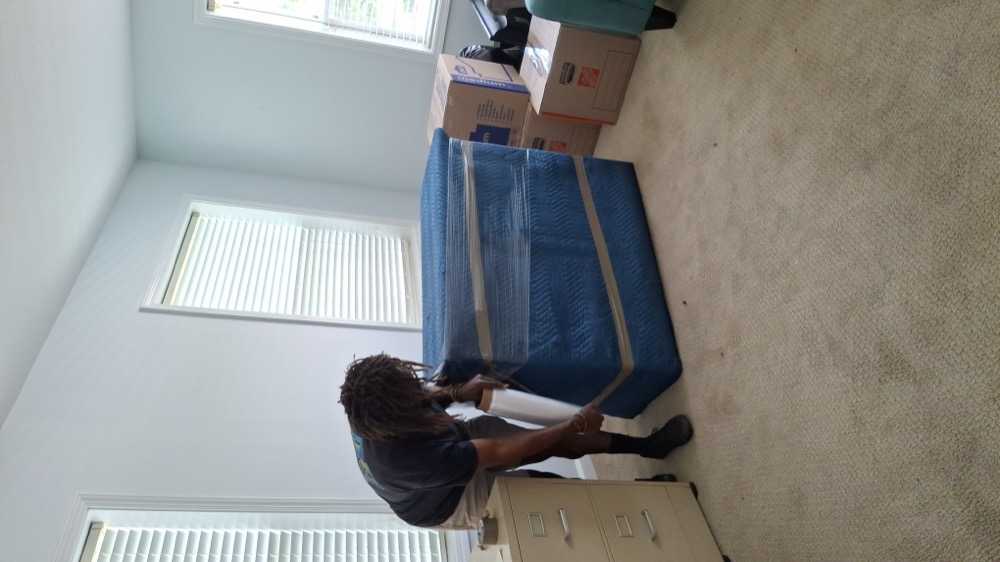
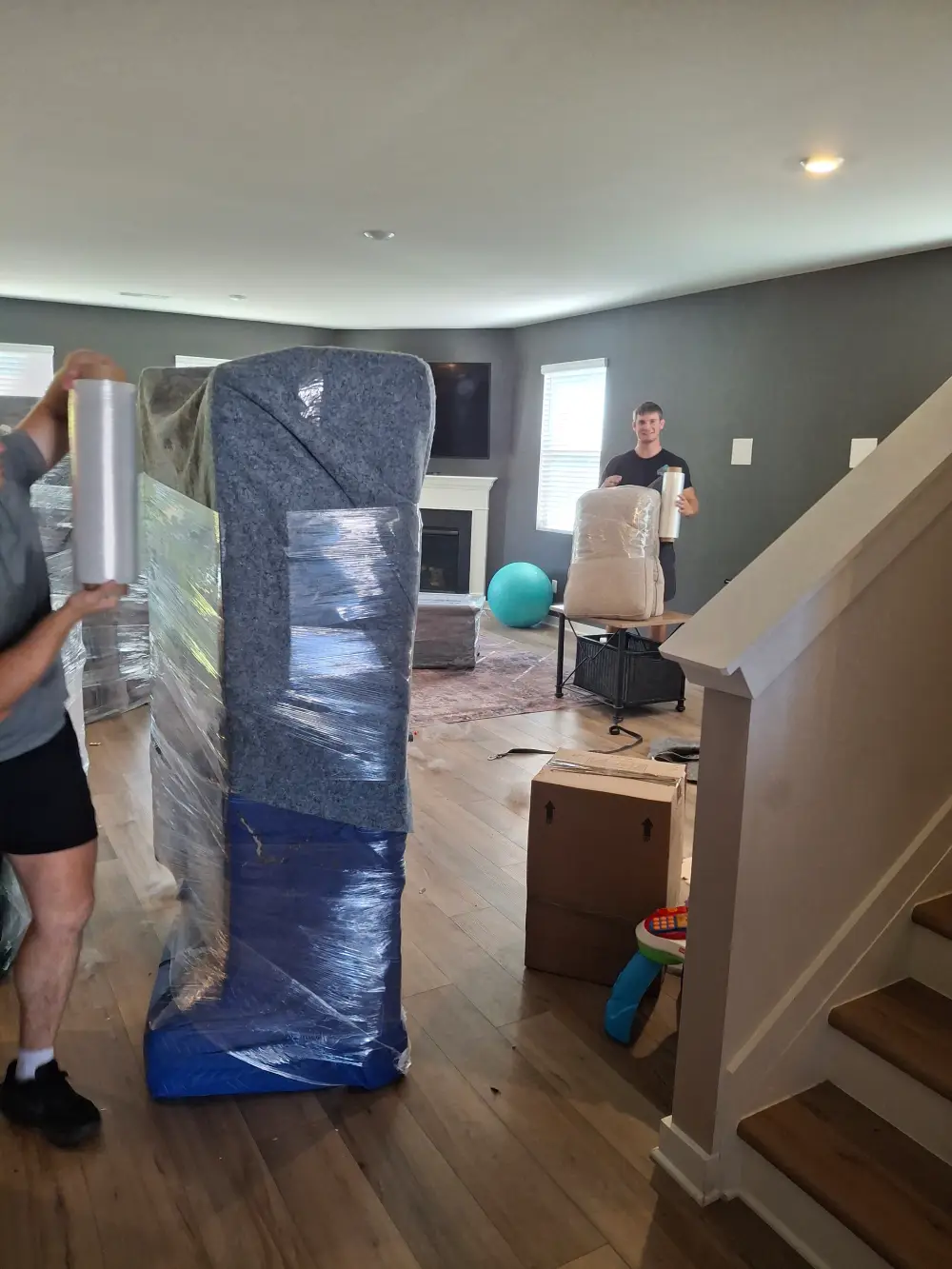
Every solid-wood surface is wrapped using a triple-layer protocol:
- Layer 1 — Breathable barrier: A clean moving blanket or cloth pad placed directly against the finish. This layer must never be plastic; raw wood finish needs to off-gas and regulate moisture, and non-breathable film trapped against a warm surface for hours causes condensation to bead directly on the lacquer.
- Layer 2 — Shock-absorbing padding: Foam or additional quilted padding layered over the breathable wrap at corners, edges, and any carved or inlaid detail — the points most likely to take a direct impact load.
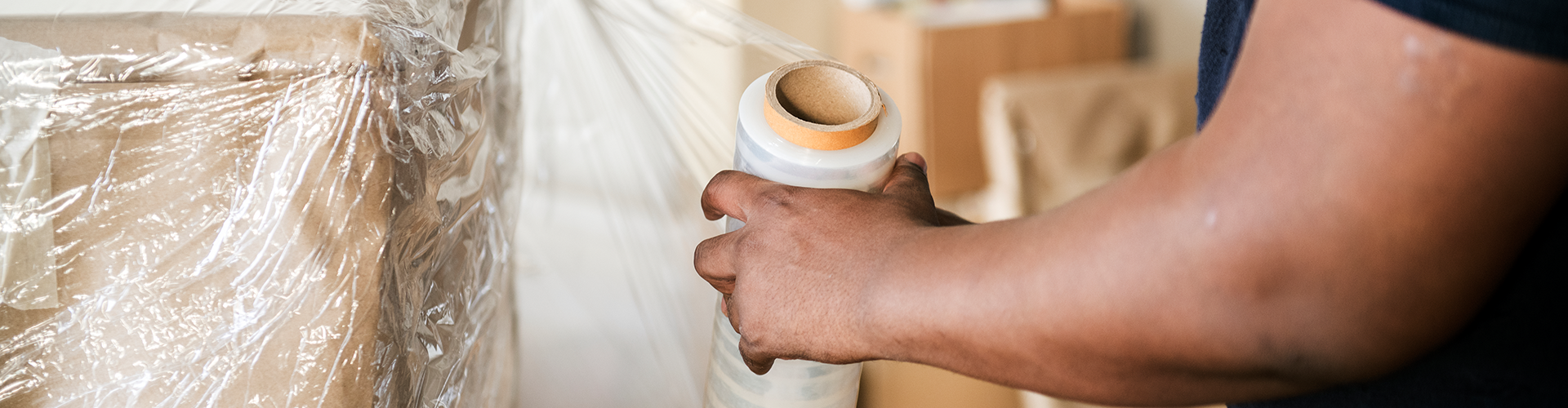
- Layer 3 — Outer stretch-wrap: Industrial stretch film applied over the padding, never touching the wood itself, to compress the layers and hold them in place through loading, transit, and unloading.
Tape is never applied directly to a wood surface at any point in this process — not even to a corner or an edge. Adhesive residue and the finish-lifting reaction it causes are among the most common (and entirely preventable) damage claims in high-end residential moving.
Section 3: Deconstructing Complex Multi-Piece & Custom Storage Systems
Modular Wall Units & Executive Desks
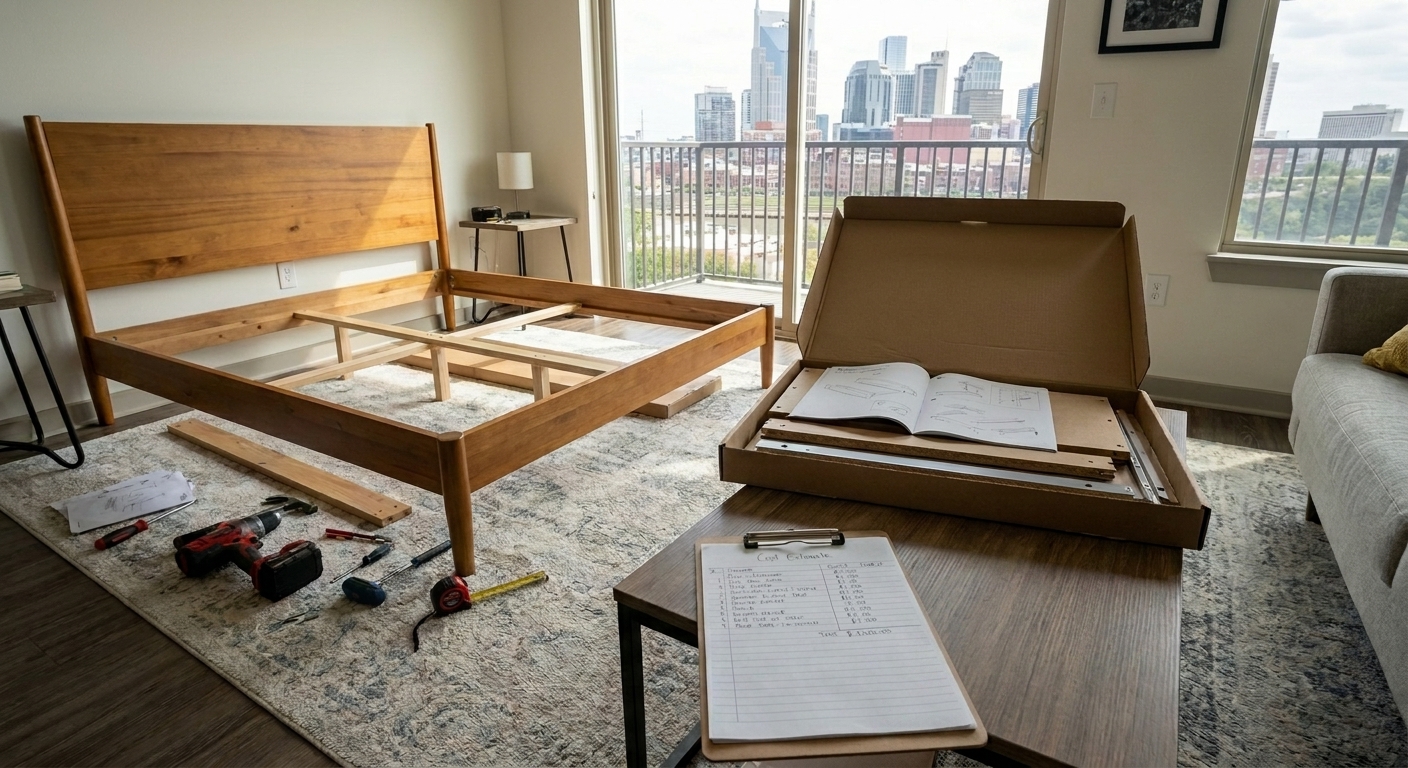
Modular office suites, built-in-style entertainment walls, and sectional storage systems are systematically unbolted in a defined sequence — top-down, outer sections before structural anchors — with every fastener, cam lock, dowel, and shelf pin isolated using a bag-and-tag system: each hardware set is bagged, labeled with its originating section and orientation, and logged against a numbered diagram of the unit. This is what makes moving complex wall units across Middle Tennessee homes — and reassembling them exactly as they were — possible without guesswork on the other end.
Heavy Armoires, Dressers, and Built-Ins
Before any armoire, dresser, or built-in cabinet is moved, drawers, adjustable glass or wood shelving, and mirrors are fully removed — never taped or left in place. A loaded drawer or a floating shelf becomes an independent mass inside the case during transport; every tilt or stop sends that mass sliding or shifting, which transfers unpredictable internal momentum into the frame itself rather than the load staying fixed and predictable. On tight indoor stairwells, that unremoved internal weight is also what most often overloads a single stair tread or subfloor joist, since the load is no longer evenly distributed across the piece's base.
Spatial Physics in Tight Corridors
Ninety-degree hallway turns, double-door thresholds, and grand staircases are navigated using two coordinated techniques:
- The L-shape rotation: Rather than forcing a large case piece through a turn on a single plane, the crew pivots the piece through an intermediate diagonal position, briefly aligning it with the diagonal of the hallway or landing before rotating it into the new corridor — eliminating the pinch point where corners typically strike doorframes or newel posts.
- High-low carrying: One crew member carries the leading edge high, the other the trailing edge low, keeping the piece's center of mass constantly over a stable base of support and off any single fragile joint — critical on staircases, where a flat, level carry would force the lower corner into the stair nosing.
Both methods exist for the same reason: to move a heavy case piece through a confined space using rotation and repositioning, never leverage against a joint, hinge, or attached decorative element.
Section 4: Direct-Chain Accountability & Professional Crew Execution
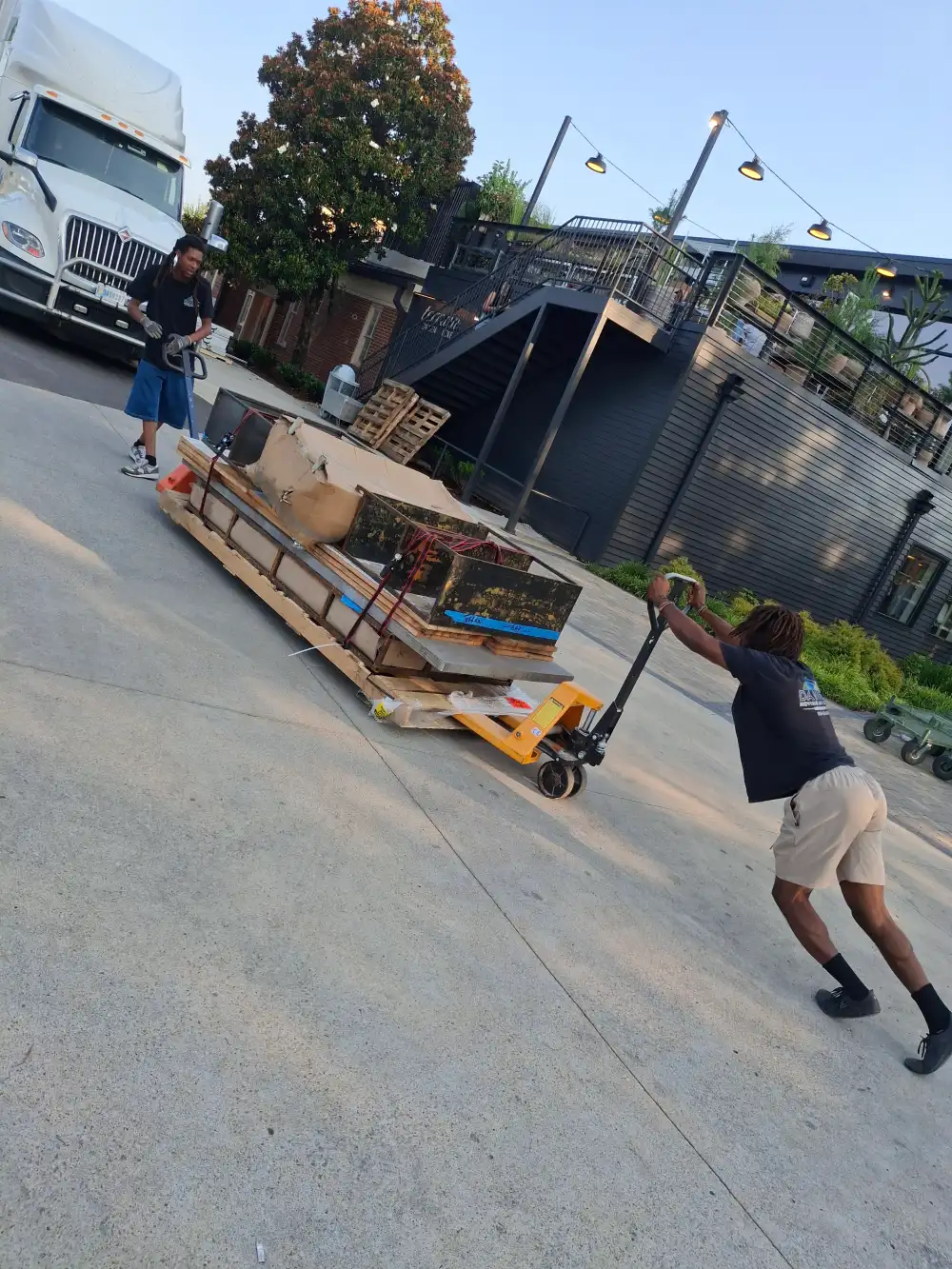
Every piece described above is handled by fully background-checked, dedicated in-house crews — never subcontracted labor. Crews work with specialized furniture dollies, non-marking composite ramps, and heavy-duty E-track strap systems secured inside our dedicated 26-foot box trucks, built specifically to keep large case pieces and modular sections stable and separated during transit.
This is a direct chain of custody: the same crew that disassembles, bags-and-tags, and wraps your custom storage system or solid-wood furniture is the crew that unloads, reassembles, and levels it in your new home. Nothing changes hands between teams.
Scope of specialization: Our crews specialize in premium household goods, fine solid-wood furniture, custom and modular storage systems, and executive office pieces. We do not handle commercial gym equipment or outdoor playground systems — this is a deliberate operational boundary that keeps our crews focused entirely on the fine-furniture skill set described in this guide.
Section 5: Schedule a Walkthrough
If your move involves solid hardwood furniture, a custom modular wall system, or a multi-piece executive office, a generic moving estimate isn't enough — it needs to be assessed piece by piece. Our team offers in-home and virtual walkthroughs for exactly this kind of moving heavy solid wood furniture nashville work, evaluating joinery, disassembly points, and access constraints before your move date, not on it.
We work with homeowners, interior designers, and estate managers throughout Davidson and Williamson counties on solid hardwood furniture movers projects, and our white glove furniture disassembly movers process is built around the exact protocols outlined above — never generic blanket-and-tape handling.
To schedule your assessment, contact us for a walkthrough estimate.
‹ Back
Recent Posts
-
-
-
-
Commercial Property Emergency Pack-Out Services
October 6, 2026
-