

The Logistics of a Multi-Day Move: What to Expect for Homeowners Over 5,000 Square Feet
The Complexity of Scale
A home over 5,000 square feet is not a larger version of a standard residential move. It is a different category of logistical operation entirely — one that shares almost nothing with the mechanics of moving a 2-bedroom apartment or a 2,500-square-foot suburban home.
Consider the arithmetic. A 5,000-square-foot estate typically contains six to eight bedrooms, four to six full bathrooms, a primary suite with a separate sitting room, a formal dining room, a catering kitchen, a study or library, multiple living areas, and some combination of media room, wine cellar, home gym, and staff quarters. Each of those rooms contains furniture systems, art, lighting, textiles, and accumulated contents that must be catalogued, wrapped, staged, loaded, transported, and placed at the destination with specific intent.
Attempting to compress that scope into a single moving day does not just create a rushed outcome — it creates compounding risk. Crew fatigue in hours 10 and 12 of a 14-hour push is where damage occurs. Decisions about where to place furniture get made quickly by an exhausted crew rather than precisely with the homeowner. High-value items get loaded in whatever sequence is fastest rather than the sequence that protects them best. The race against the clock produces exactly the kind of handling errors that a $3.4 million Belle Meade estate or a Leiper's Fork property on private acreage cannot absorb.
The multi-day phased relocation is how large-scale residential transitions are executed correctly. It is not a luxury upgrade — it is the operationally appropriate response to the physical scope of what's being moved.
The most dangerous moment in a large estate move is hour 11 of a crew that has been working since 7am. Fatigue is when things break, get scratched, and get set down in the wrong room. The phased model eliminates that risk by design.
The Chronological Phase Mapping
What follows is the operational sequence Daniel's Moving and Logistics deploys for residential properties over 5,000 square feet. The specific timeline within each phase is adjusted to the property's actual inventory during the pre-move walkthrough — no two estate moves are identical, and the phase plan reflects the specific home, not a generic template.
PHASE 1 — Day 1: Full-Service Packing, Wrapping, and Spatial Staging
Day 1 is not a moving day. Nothing leaves the property. Day 1 is the preparation day — the phase where every item that will move is protected, labeled, and positioned for maximum loading efficiency on Day 2.
Room-by-room packing sequence: The crew moves through the home in a defined sequence, working from the rooms that are least disruptive to the homeowner's final days in the property toward the rooms that are most essential. Guest rooms and secondary bedrooms typically wrap first. The primary suite, study, and kitchen — the spaces the homeowner is still actively using — are packed last, often in the final hours of Day 1 or the first hours of Day 2.
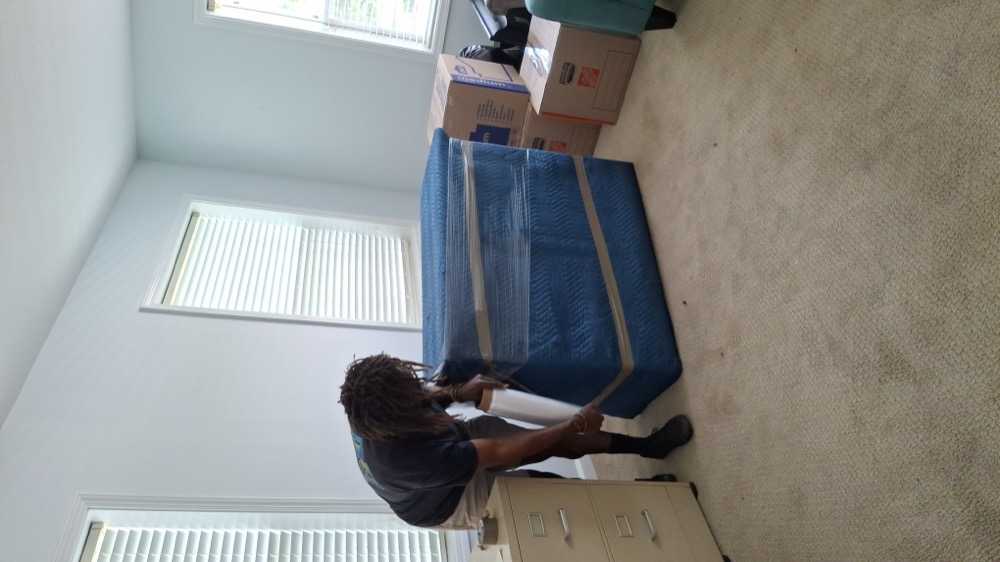
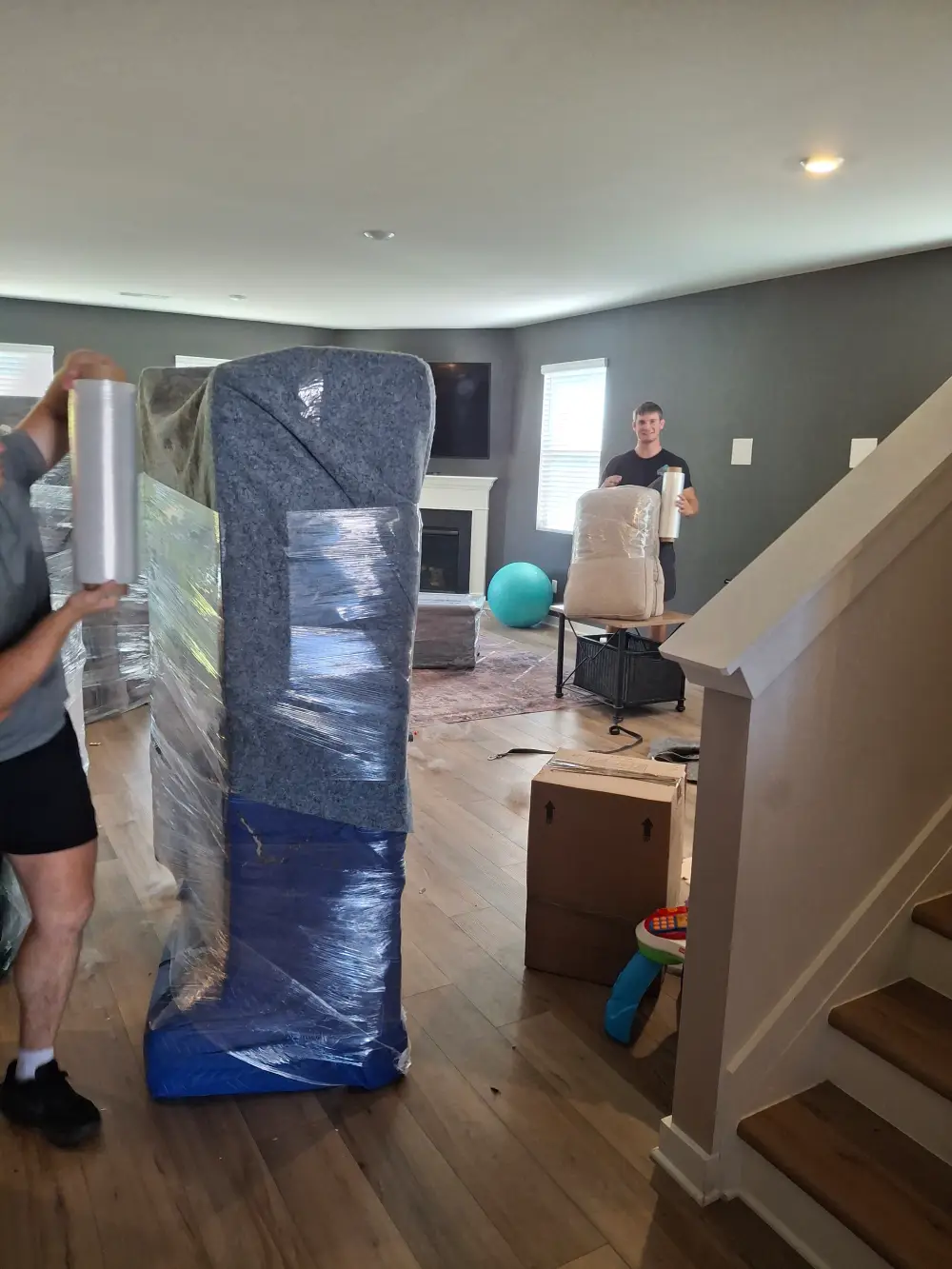
Multi-layer wrapping of furniture systems: Every piece of furniture that moves is wrapped on Day 1, not on the loading day. Heavyweight quilted moving blankets go on first, with corner guards on every exposed edge and leg. Shrink wrap seals the package over the blanket layer. Fabric pieces receive blanket coverage plus a full shrink wrap seal. This sequencing means Day 2's loading crew is working with fully protected, ready-to-load inventory rather than wrapping and loading simultaneously — which is the workflow that produces damage.
The staging concept: As rooms are packed and wrapped, items move into a central staging area — typically the garage, the main floor foyer, or a cleared first-floor room. This staging area functions as a pre-load zone where wrapped furniture and packed boxes accumulate in load-order sequence throughout Day 1. When the truck arrives on Day 2, the loading crew is not walking through a fully furnished home and pulling items one at a time. They are loading from a staged, organized inventory that has already been sequenced.
Labeling discipline: Every box receives a destination room label and a content category label. Every piece of wrapped furniture receives a destination room tag. The crew lead maintains a move manifest — a running inventory of what has been staged and what remains. For a 5,000+ square foot property, this manifest is the document that prevents the Day 3 question: where is the lamp from the upstairs sitting room?
Day 1 is the most important day of a multi-day estate move. How well it is executed determines whether Day 2 and Day 3 are controlled operations or recovery operations.
PHASE 2 — Day 2: Tactical Fleet Loading and Transit Logistics
Day 2 is the physical loading and transit day. The staging work from Day 1 pays off immediately: the crew loads from an organized inventory rather than improvising through a still-inhabited home.
Load tier engineering: A 26-foot commercial box truck is loaded in deliberate tiers, not filled opportunistically. Heavy structural items — sofa sectionals, bed frames, armoires, solid wood dining tables — go in first at the base tier, anchored with E-track tie-down straps at multiple points against the truck walls. This base layer is the structural foundation of the load. The mid-tier fills with medium-weight items — dressers, case pieces, packed totes — positioned and strapped to prevent lateral movement. The top tier carries the lightest packed boxes, never under any weight they weren't designed to bear. Art, mirrors, and fragile framed pieces travel completely vertical against the padded truck walls, individually strapped, isolated from all contact with other items.
Multi-truck synchronization: Most properties over 5,000 square feet require more than one truck. The loading sequence for multiple trucks is coordinated so that each truck carries a cohesive destination zone — not a random mix of items from across the property. Truck one might carry the primary suite, library, and formal dining room. Truck two carries secondary bedrooms and living spaces. This destination-zone loading makes Day 3 unloading organized rather than chaotic, because each truck delivers a self-contained section of the home's inventory.
Neighborhood transit coordination: For estate properties in Belle Meade — where quiet, winding streets like Sunnyside Drive and Lynnwood Boulevard were not designed for commercial vehicle convoys — and for rural acreage properties in Leiper's Fork and College Grove with long private driveways and gated entries, multi-truck departure and arrival timing is coordinated to prevent simultaneous truck staging in areas that cannot accommodate it. Trucks depart in sequence and arrive at the destination on a staggered schedule that prevents congestion at both the origin and destination addresses.
PHASE 3 — Day 3: Precision Placement, Assembly, and Handoff
Day 3 is where the planning of Day 1 and the execution of Day 2 produce their outcome: a new home that is set up, not just unloaded.
The arrival walkthrough: Before a single item comes off the first truck at the destination, the crew lead does a room-by-room walkthrough of the new property with the homeowner or their designated representative. This walkthrough confirms furniture placement — specifically the orientation of large pieces within each room — and identifies any access challenges at the new address (narrow doorways, staircase dimensions, elevator access in a Gulch or Green Hills high-rise) that should be accounted for before loading begins. Ten minutes of walkthrough prevents four hours of re-arrangement.
Synchronized room-by-room distribution: Trucks unload in destination-zone sequence. The crew distributes items directly to their confirmed destination rooms rather than staging everything in the foyer and sorting afterward. Each box and each furniture piece goes to its room, in the sequence that allows the crew to work through the home systematically from one end to the other without backtracking. Color-coded labels make this process fast — any crew member can direct any box to the right room without stopping to read handwriting.
Furniture assembly: Bed frames, complex furniture systems, modular shelving, and any piece that was disassembled for transport is reassembled at the destination on Day 3 before the crew departs. The homeowner does not wake up the next morning with a bedroom in pieces. Assembly is part of the Day 3 scope — not an additional service negotiated on the spot.
The final walkthrough and handoff: Before the crew leaves, the homeowner or their representative walks every room with the crew lead to confirm placement, confirm assembly is complete, and note anything that requires follow-up. The handoff is the formal close of the multi-day engagement — and it happens with the home set up and the homeowner satisfied, not with a crew loading back into trucks while items are still in hallways.
Fleet Flexibility and HOA Operational Discipline
Large estate moves in Middle Tennessee's luxury submarkets present physical and regulatory constraints that do not exist in standard residential neighborhoods. Addressing them in advance is not optional — they directly determine whether the move executes on schedule or encounters avoidable disruptions on loading and delivery days.
Private Driveways, Rural Acreage, and Williamson County Terrain
The rural estate communities south and west of Nashville — Leiper's Fork, College Grove, Arrington — feature private driveways that may run several hundred feet from the road to the home, with variable surface conditions (gravel, packed dirt, asphalt) and grade changes that affect how a loaded 26-foot truck approaches and stages. A truck that sinks a wheel into soft gravel shoulder on a College Grove estate driveway in July — after a week of summer rain — is not a scheduling inconvenience. It is a multi-hour delay on a day that has no slack built into it.
We assess private driveway conditions and surface type as part of the pre-move walkthrough. If a private driveway cannot safely support a loaded 26-foot truck, we identify the appropriate staging distance and use equipment to manage the carry from that position — before moving day, not when the truck is already committed to an approach angle.
Belle Meade's Quiet Streets and the Staging Reality
Belle Meade's residential streets — Belle Meade Boulevard, Westview Avenue, Sunnyside Drive, the internal streets of the Governor's Club and Laurelbrooke communities — are quiet, mature-canopied, and definitively not designed for commercial vehicle staging. The city of Belle Meade operates its own police department and enforces its own municipal regulations, which are distinct from Metro Nashville's. Commercial truck parking in Belle Meade requires awareness of city-specific requirements that differ from what applies in a standard Davidson County neighborhood.
Multi-truck convoys on Belle Meade's internal streets require sequenced arrival and staggered staging positions to avoid blocking through-traffic and neighboring property access. This is pre-planned, not improvised. Our drivers know Belle Meade's street layout before they arrive with a full load.
HOA Move-In Windows in Brentwood and Franklin Estate Communities
Gated communities throughout Williamson County — Governor's Club, Laurelbrooke, The Grove, and comparable premium communities in Franklin — have HOA-enforced move-in windows, gate access codes that require advance coordination with community management, and sometimes Certificate of Insurance requirements from the moving company before access is granted. Missing a Williamson County HOA move-in window on Day 2 of a multi-day move creates a cascading problem: the staging from Day 1 is sitting in a truck, and the destination address is not accessible until the HOA resolves the access issue.
We handle HOA coordination as part of pre-move planning — not as a Day-of phone call. Gate access codes, move-in window confirmation, and any COI documentation are in hand before the first truck is loaded.
One Consistent Team Across All Three Days
Multi-day projects executed by different crew configurations on different days are a structural problem that produces inconsistent outcomes. The crew lead who directed Day 1 staging has institutional knowledge of where items are, how they were wrapped, and what the manifest says. A different crew on Day 2 does not have that knowledge — and the loading decisions reflect it.
Daniel's Moving and Logistics assigns one consistent, background-checked crew to a multi-day estate project from Day 1 walkthrough through Day 3 handoff. The same people who staged the library on Day 1 are the people who load it on Day 2 and place it on Day 3. No crew rotation. No institutional knowledge gaps between days.
Planning Your Multi-Day Estate Move
For homes over 5,000 square feet — whether that's a Belle Meade Tudor Revival on Belle Meade Boulevard, a Brentwood estate in Laurelbrooke, a custom build on acreage in College Grove, or a gated Franklin property in Westhaven — a multi-day move is not a service upgrade. It is the operationally correct approach to a scope that a single day cannot safely accommodate.
The consultation for a multi-day project begins with an on-site walkthrough — not a phone call and a rough estimate. We assess the property, the inventory, the access conditions at both addresses, and the HOA or community requirements, and we build a phase plan specific to your move. That walkthrough needs to happen 4 to 6 weeks before your target move date to allow time for scheduling the multi-day window during peak summer season and confirming all access requirements in advance.
Call 615-481-3098 or contact us to schedule your pre-move consultation and reserve your multi-day project window.
Frequently Asked Questions: Multi-Day Moves for Large Estates
How many days does it take to move a home over 5,000 square feet?
A home over 5,000 square feet typically requires 3 days to move correctly: Day 1 for full-service packing, wrapping, and staging; Day 2 for truck loading and transit; and Day 3 for precision placement, furniture assembly, and final walkthrough at the destination. Some larger properties — 7,000 to 10,000+ square feet with significant art collections or highly complex furniture systems — may require an additional staging day. Attempting to compress a 5,000+ square foot estate move into a single day creates compounding risk of damage to high-value assets and property from crew fatigue and time pressure.
What is the staging concept in a multi-day estate move?
In a multi-day estate move, staging refers to the process of moving packed boxes and wrapped furniture from throughout the home into a central pre-load zone — typically a cleared garage, a main floor foyer, or a designated staging room — during the Day 1 packing phase. This staging area acts as a sequenced inventory that the Day 2 loading crew draws from directly, rather than walking through an inhabited home pulling items one at a time. Effective staging on Day 1 is the primary factor that determines whether Day 2 loading is controlled and efficient or chaotic and slow.
How does multi-truck coordination work for a large estate move?
For estate properties over 5,000 square feet requiring multiple trucks, the most effective approach is destination-zone loading: each truck carries a cohesive section of the home's inventory — one truck for the primary suite and library, another for secondary bedrooms and living spaces, for example — rather than randomly mixing items from across the property across trucks. Trucks depart in sequenced timing and arrive at the destination on a staggered schedule to prevent simultaneous congestion at both addresses, particularly important for properties in Belle Meade, Leiper's Fork, and gated Williamson County communities with restricted access.
What HOA requirements affect large estate moves in Brentwood and Franklin?
Gated communities in Brentwood and Franklin — including Governor's Club, Laurelbrooke, The Grove, Westhaven, and comparable communities — typically enforce HOA move-in windows, require advance gate access code coordination with community management, and may require a Certificate of Insurance from the moving company before granting access. These requirements must be confirmed before the project's first loading day, not on the morning of the move. Missing an HOA access window on a multi-day project disrupts the entire phase schedule.
Does Daniel's Moving and Logistics handle multi-day estate moves in Belle Meade and Leiper's Fork?
Yes. Daniel's Moving and Logistics handles multi-day estate relocation projects for properties over 5,000 square feet throughout Davidson and Williamson counties, including Belle Meade, Green Hills, Brentwood, Franklin, College Grove, Leiper's Fork, and surrounding areas. Our multi-day projects use one consistent background-checked crew across all three phases, dedicated 26-foot commercial box trucks, and a pre-move walkthrough consultation. Call 615-481-3098 or contact us to schedule your consultation 4 to 6 weeks before your target move date.
Daniel's Moving and Logistics LLC | Nashville, TN | 615-481-3098 | danielsmovingandlogisticsllc.com | BBB A+ Accredited | Serving Middle Tennessee's Luxury Estate Markets
‹ Back
Recent Posts
-
-
-
-
Commercial Property Emergency Pack-Out Services
October 6, 2026
-